
JWT Service Tickets
JSON Web Tokens are an open, industry standard RFC 7519 method for representing claims securely between two parties. CAS may also be allowed to fully create signed/encrypted JWTs and pass them back to the application in form of service tickets.
JWTs are entirely self-contained and contain the authenticated principal as well as all authorized attributes in form of JWT claims.
 JCE Requirement
Make sure you have the proper JCE bundle installed in your Java
environment that is used by CAS, specially if you need to use specific signing/encryption algorithms and methods. Be sure to pick
the right version of the JCE for your Java version. Java versions can be detected via the java -version command.
Overview
JWT-based service tickets are issued to application based on the same semantics defined by the CAS Protocol.
CAS having received an authentication request via its /login endpoint will conditionally issue back JWT service tickets to the
application in form of a ticket parameter via the requested http method.
All JWTs are by default signed and encrypted by CAS based on keys generated and controlled during deployment. Such keys may be exchanged with client applications to unpack the JWT and access claims.
Flow Diagram
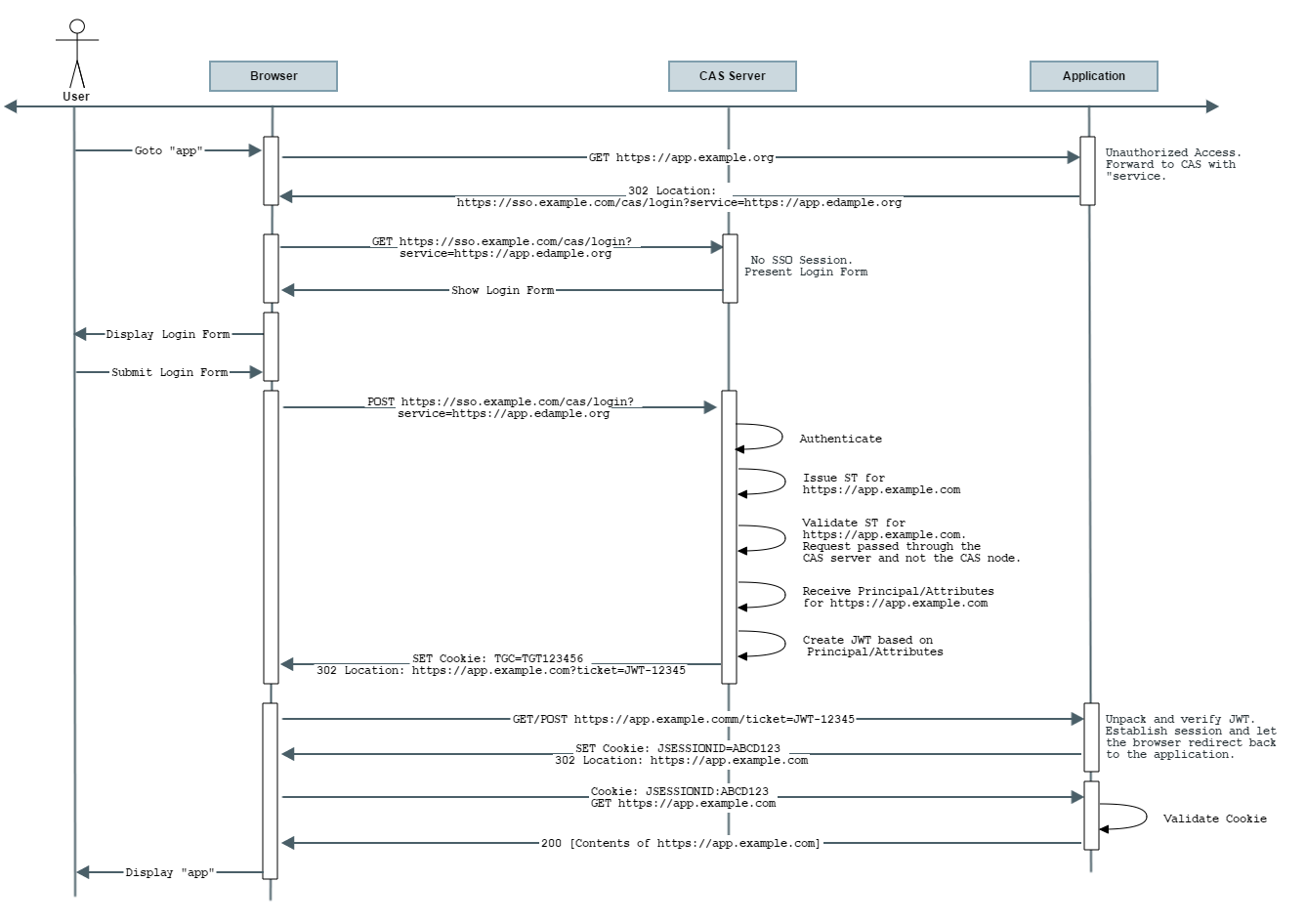
Note that per the above diagram, the JWT request by default internally causes CAS to generate an ST for the application and immediately then validate it in
order to get access to the authenticated principal and attributes per policies associated with the application registration record in the
CAS service registry. This response is transformed into a JWT that is then passed onto the client application.
In other words, the responsibility of receiving a service ticket (ST) and validating it is all moved into and handled internally by CAS.
The application only needs to learn how to decipher and unpack the final JWT and ensure its validity.
The expiration time of the generated JWT is controlled by the length of the assertion returned as part of the validation event. If the
assertion validity length is not specified, then the expiration time is controlled by the length of the SSO session defined as part of SSO expiration policy of the CAS server.
 Not OpenID Connect
Remember that you are just receiving a ticket in form of a JWT, thereby removing the need from your client to validate a normal service ticket. The ticket is internally validated by CAS and you as the client are only left in charge of validating the JWT itself. Do not confuse this with OpenID Connect. While a JWT, the token itself is not an ID token, cannot be refreshed and must be obtained again once you deem it expired. If you need more, consider using the OpenID Connect protocol instead. Note that the responsibility of validating the JWT is pushed onto the client and NOT the CAS server itself.
Actuator Endpoints
The following endpoints are provided by CAS:
jwtTicketSigningPublicKey
| Name | In | Type | Description |
|---|---|---|---|
service |
query | – | The service to look up |
- Returns
String- Produces
text/plain- Java method
fetchPublicKey(String)- Defined in
JwtTokenCipherSigningPublicKeyEndpoint
Turn the endpoint on and expose it over the web.
One entry covers every operation. By default only info, health and status are exposed.
1
2

management.endpoint.jwtTicketSigningPublicKey.access=UNRESTRICTED
management.endpoints.web.exposure.include=jwtTicketSigningPublicKey
1
2
3
4
5
6
7
8

management:
  endpoint:
    jwtTicketSigningPublicKey:
      access: "UNRESTRICTED"
  endpoints:
    web:
      exposure:
        include: "jwtTicketSigningPublicKey"
1
2

MANAGEMENT_ENDPOINT_JWTTICKETSIGNINGPUBLICKEY_ACCESS=UNRESTRICTED
MANAGEMENT_ENDPOINTS_WEB_EXPOSURE_INCLUDE=jwtTicketSigningPublicKey
Endpoints may be mapped to other paths. For example, to serve health at healthcheck:
1

management.endpoints.web.path-mapping.health=healthcheck
Once exposed, every call goes through Spring Security,
and CAS decides access per endpoint. Without a rule, the special defaults endpoint applies, which denies access.
1

cas.monitor.endpoints.endpoint.jwtTicketSigningPublicKey.access=AUTHENTICATED
1
2
3
4
5
6

cas:
  monitor:
    endpoints:
      endpoint:
        jwtTicketSigningPublicKey:
          access: "AUTHENTICATED"
1

CAS_MONITOR_ENDPOINTS_ENDPOINT_JWTTICKETSIGNINGPUBLICKEY_ACCESS=AUTHENTICATED
1
2

cas.monitor.endpoints.endpoint.jwtTicketSigningPublicKey.access=ROLE
cas.monitor.endpoints.endpoint.jwtTicketSigningPublicKey.required-roles=ADMIN
1
2
3
4
5
6
7

cas:
  monitor:
    endpoints:
      endpoint:
        jwtTicketSigningPublicKey:
          access: "ROLE"
          required-roles: "ADMIN"
1
2

CAS_MONITOR_ENDPOINTS_ENDPOINT_JWTTICKETSIGNINGPUBLICKEY_ACCESS=ROLE
CAS_MONITOR_ENDPOINTS_ENDPOINT_JWTTICKETSIGNINGPUBLICKEY_REQUIREDROLES=ADMIN
1
2

cas.monitor.endpoints.endpoint.jwtTicketSigningPublicKey.access=IP_ADDRESS
cas.monitor.endpoints.endpoint.jwtTicketSigningPublicKey.required-ip-addresses=127.0.0.1
1
2
3
4
5
6
7

cas:
  monitor:
    endpoints:
      endpoint:
        jwtTicketSigningPublicKey:
          access: "IP_ADDRESS"
          required-ip-addresses: "127.0.0.1"
1
2

CAS_MONITOR_ENDPOINTS_ENDPOINT_JWTTICKETSIGNINGPUBLICKEY_ACCESS=IP_ADDRESS
CAS_MONITOR_ENDPOINTS_ENDPOINT_JWTTICKETSIGNINGPUBLICKEY_REQUIREDIPADDRESSES=127.0.0.1
1

cas.monitor.endpoints.endpoint.jwtTicketSigningPublicKey.access=PERMIT
1
2
3
4
5
6

cas:
  monitor:
    endpoints:
      endpoint:
        jwtTicketSigningPublicKey:
          access: "PERMIT"
1

CAS_MONITOR_ENDPOINTS_ENDPOINT_JWTTICKETSIGNINGPUBLICKEY_ACCESS=PERMIT
A single user defined in CAS settings. If the name and password are left undefined, CAS generates them at startup.
spring.security.user.nameDefault user name.
userDefault user name.
spring.security.user.passwordPassword for the default user name.
Password for the default user name.
spring.security.user.rolesGranted roles for the default user name.
Granted roles for the default user name.
cas.monitor.endpoints.jaas.login-configJAAS login resource file.
JAAS login resource file.
cas.monitor.endpoints.jaas.login-context-nameThe login context name should coincide with a given index in the login config specified.
The login context name should coincide with a given index in the login config specified. This name is used as the index to the configuration specified in the login config property.
JAASTest { org.springframework.security.authentication.jaas.TestLoginModule required; }; In the above example, JAASTest should be set as the context name.cas.monitor.endpoints.jaas.refresh-configuration-on-startupIf set, a call to Configuration#refresh() will be made by #configureJaas(Resource) method.
trueIf set, a call to Configuration#refresh() will be made by #configureJaas(Resource) method.
cas.monitor.endpoints.ldap.base-dnBase DN to use.
Base DN to use. There may be scenarios where different parts of a single LDAP tree could be considered as base-dns. Rather than duplicating the LDAP configuration block for each individual base-dn, each entry can be specified and joined together using a special delimiter character. The user DN is retrieved using the combination of all base-dn and DN resolvers in the order defined. DN resolution should fail if multiple DNs are found. Otherwise the first DN found is returned. Usual syntax is: subtreeA,dc=example,dc=net|subtreeC,dc=example,dc=net.
cas.monitor.endpoints.ldap.bind-credentialThe bind credential to use when connecting to LDAP.
The bind credential to use when connecting to LDAP.
cas.monitor.endpoints.ldap.bind-dnThe bind DN to use when connecting to LDAP.
-
bindDn/bindCredentialprovided - Use the provided credentials to bind when initializing connections. -
bindDn/bindCredentialset to*- Use a fast-bind strategy to initialize the pool. -
bindDn/bindCredentialset to blank - Skip connection initializing; perform operations anonymously. - SASL mechanism provided - Use the given SASL mechanism to bind when initializing connections.
cas.monitor.endpoints.ldap.ldap-urlThe LDAP url to the server.
The LDAP url to the server. More than one may be specified, separated by space and/or comma.
cas.monitor.endpoints.ldap.search-filterUser filter to use for searching.
User filter to use for searching. Syntax is cn={user} or cn={0}.
You may also provide an external groovy script in the syntax of file:/path/to/GroovyScript.groovy to fully build the final filter template dynamically.
cas.monitor.endpoints.ldap.typeThe authentication type.
AUTHENTICATED-
AD- Users authenticate withsAMAccountName. -
AUTHENTICATED- Manager bind/search type of authentication. If {@code} principalAttributePassword} is empty then a user simple bind is done to validate credentials. Otherwise the given attribute is compared with the givenprincipalAttributePasswordusing theSHAencrypted value of it. -
ANONYMOUS: Similar semantics asAUTHENTICATEDexcept nobindDnandbindCredentialmay be specified to initialize the connection. IfprincipalAttributePasswordis empty then a user simple bind is done to validate credentials. Otherwise the given attribute is compared with the givenprincipalAttributePasswordusing theSHAencrypted value of it. - DIRECT: Direct Bind - Compute user DN from format string and perform simple bind. This is relevant when no search is required to compute the DN needed for a bind operation. Use cases for this type are: 1) All users are under a single branch in the directory,
e.g. ou=Users,dc=example,dc=org.2) The username provided on the CAS login form is part of the DN, e.g.uid=%s,ou=Users,dc=example,dc=org.
-
AD: Active Directory. -
AUTHENTICATED: Authenticated Search. -
DIRECT: Direct Bind. -
ANONYMOUS: Anonymous Search.
cas.monitor.endpoints.ldap.allow-multiple-dnsWhether search/query results are allowed to match on multiple DNs, or whether a single unique DN is expected for the result.
falseWhether search/query results are allowed to match on multiple DNs, or whether a single unique DN is expected for the result.
cas.monitor.endpoints.ldap.allow-multiple-entriesSet if multiple Entries are allowed.
falseSet if multiple Entries are allowed.
cas.monitor.endpoints.ldap.binary-attributesIndicate the collection of attributes that are to be tagged and processed as binary attributes by the underlying search resolver.
Indicate the collection of attributes that are to be tagged and processed as binary attributes by the underlying search resolver.
cas.monitor.endpoints.ldap.block-wait-timeThe length of time the pool will block.
PT3SThe length of time the pool will block. By default the pool will block indefinitely and there is no guarantee that waiting threads will be serviced in the order in which they made their request. This option should be used with a blocking connection pool when you need to control the exact number of connections that can be created
cas.monitor.endpoints.ldap.connect-timeoutSets the maximum amount of time that connects will block.
PT5SSets the maximum amount of time that connects will block.
cas.monitor.endpoints.ldap.connection-strategyIf multiple URLs are provided as the ldapURL this describes how each URL will be processed.
-
ACTIVE_PASSIVEFirst LDAP will be used for every request unless it fails and then the next shall be used. -
ROUND_ROBINFor each new connection the next url in the list will be used. -
RANDOMFor each new connection a random LDAP url will be selected. -
DNS_SRVLDAP urls based on DNS SRV records of the configured/given LDAP url will be used.
cas.monitor.endpoints.ldap.deref-aliasesDefine how aliases are de-referenced.
NEVER-
SEARCHING: dereference when searching the entries beneath the starting point but not when searching for the starting entry. -
FINDING: dereference when searching for the starting entry but not when searching the entries beneath the starting point. -
ALWAYS: dereference when searching for the starting entry and when searching the entries beneath the starting point.
cas.monitor.endpoints.ldap.disable-poolingWhether to use a pooled connection factory in components.
falseWhether to use a pooled connection factory in components.
cas.monitor.endpoints.ldap.dn-formatSpecify the dn format accepted by the AD authenticator, etc.
Specify the dn format accepted by the AD authenticator, etc. Example format might be uid=%s,ou=people,dc=example,dc=org.
cas.monitor.endpoints.ldap.enhance-with-entry-resolverWhether specific search entry resolvers need to be set on the authenticator, or the default should be used.
trueWhether specific search entry resolvers need to be set on the authenticator, or the default should be used.
cas.monitor.endpoints.ldap.fail-fastAttempt to populate the connection pool early on startup and fail quickly if something goes wrong.
trueAttempt to populate the connection pool early on startup and fail quickly if something goes wrong.
cas.monitor.endpoints.ldap.follow-referralsSet if search referrals should be followed.
trueSet if search referrals should be followed.
cas.monitor.endpoints.ldap.hostname-verifierHostname verification options.
DEFAULT-
DEFAULT: Default option, forcing verification. -
ANY: Skip hostname verification and allow all.
cas.monitor.endpoints.ldap.idle-timeRemoves connections from the pool based on how long they have been idle in the available queue.
PT10MRemoves connections from the pool based on how long they have been idle in the available queue. Prunes connections that have been idle for more than the indicated amount.
cas.monitor.endpoints.ldap.keystorePath to the keystore used for SSL connections.
Path to the keystore used for SSL connections. Typically contains SSL certificates for the LDAP server.
cas.monitor.endpoints.ldap.keystore-passwordKeystore password.
Keystore password.
cas.monitor.endpoints.ldap.keystore-typeThe type of keystore.
The type of keystore. PKCS12 or JKS. If left blank, defaults to the default keystore type indicated by the underlying Java platform.
cas.monitor.endpoints.ldap.ldap-authz.allow-multiple-resultsIndicate whether the LDAP search query is allowed to return multiple entries.
falseIndicate whether the LDAP search query is allowed to return multiple entries.
cas.monitor.endpoints.ldap.ldap-authz.base-dnBase DN to start the search.
Base DN to start the search.
cas.monitor.endpoints.ldap.ldap-authz.group-attributeAttribute expected to be found on the entry resulting from the group search whose value is going to be used to construct roles.
Attribute expected to be found on the entry resulting from the group search whose value is going to be used to construct roles. The final value is always prefixed with #groupPrefix. This is useful in scenarios where you wish to grant access to a resource to all users who a member of a given group.
cas.monitor.endpoints.ldap.ldap-authz.group-base-dnBase DN to start the search looking for groups.
Base DN to start the search looking for groups.
cas.monitor.endpoints.ldap.ldap-authz.group-filterSearch filter to begin looking for groups.
Search filter to begin looking for groups.
cas.monitor.endpoints.ldap.ldap-authz.group-prefixA prefix that is prepended to the group attribute value to construct an authorized role.
A prefix that is prepended to the group attribute value to construct an authorized role.
cas.monitor.endpoints.ldap.ldap-authz.role-attributeAttribute expected to be found on the entry whose value is going to be used to construct roles.
uugidAttribute expected to be found on the entry whose value is going to be used to construct roles. The final value is always prefixed with #rolePrefix. This is useful in scenarios where you wish to grant access to a resource to all users who carry a special attribute.
cas.monitor.endpoints.ldap.ldap-authz.role-prefixPrefix for the role.
ROLE_Prefix for the role.
cas.monitor.endpoints.ldap.ldap-authz.search-filterLDAP search filter to locate accounts.
LDAP search filter to locate accounts.
cas.monitor.endpoints.ldap.max-pool-sizeMaximum LDAP connection pool size which the pool can use to grow.
10Maximum LDAP connection pool size which the pool can use to grow.
cas.monitor.endpoints.ldap.min-pool-sizeMinimum LDAP connection pool size.
3Minimum LDAP connection pool size. Size the pool should be initialized to and pruned to
cas.monitor.endpoints.ldap.nameName of the LDAP handler.
Name of the LDAP handler.
cas.monitor.endpoints.ldap.page-sizeRequest that the server return results in batches of a specific size.
0Request that the server return results in batches of a specific size. See RFC 2696. This control is often used to work around server result size limits. A negative/zero value disables paged requests.
cas.monitor.endpoints.ldap.pool-passivatorYou may receive unexpected LDAP failures, when CAS is configured to authenticate using DIRECT or AUTHENTICATED types and LDAP is locked down to not allow anonymous binds/searches.
BINDDIRECT or AUTHENTICATED types and LDAP is locked down to not allow anonymous binds/searches. Every second attempt with a given LDAP connection from the pool would fail if it was on the same connection as a failed login attempt, and the regular connection validator would similarly fail. When a connection is returned back to a pool, it still may contain the principal and credentials from the previous attempt. Before the next bind attempt using that connection, the validator tries to validate the connection again but fails because it’s no longer trying with the configured bind credentials but with whatever user DN was used in the previous step. Given the validation failure, the connection is closed and CAS would deny access by default. Passivators attempt to reconnect to LDAP with the configured bind credentials, effectively resetting the connection to what it should be after each bind request. Furthermore if you are seeing errors in the logs that resemble a 'Operation exception encountered, reopening connection' type of message, this usually is an indication that the connection pool’s validation timeout established and created by CAS is greater than the timeout configured in the LDAP server, or more likely, in the load balancer in front of the LDAP servers. You can adjust the LDAP server session’s timeout for connections, or you can teach CAS to use a validity period that is equal or less than the LDAP server session’s timeout. Accepted values are: -
NONE: No passivation takes place. -
BIND: The default behavior which passivates a connection by performing a bind operation on it. This option requires the availability of bind credentials when establishing connections to LDAP.
cas.monitor.endpoints.ldap.principal-attribute-passwordIf principalAttributePassword is empty then a user simple bind is done to validate credentials otherwise the given attribute is compared with the given principalAttributePassword using the SHA encrypted value of it.
If principalAttributePassword is empty then a user simple bind is done to validate credentials otherwise the given attribute is compared with the given principalAttributePassword using the SHA encrypted value of it.
For the anonymous authentication type, if principalAttributePassword is empty then a user simple bind is done to validate credentials otherwise the given attribute is compared with the given principalAttributePassword using the SHA encrypted value of it.
cas.monitor.endpoints.ldap.prune-periodRemoves connections from the pool based on how long they have been idle in the available queue.
PT2HRemoves connections from the pool based on how long they have been idle in the available queue. Run the pruning process at the indicated interval.
cas.monitor.endpoints.ldap.resolve-from-attributeIf this attribute is set, the value found in the first attribute value will be used in place of the DN.
If this attribute is set, the value found in the first attribute value will be used in place of the DN.
cas.monitor.endpoints.ldap.response-timeoutDuration of time to wait for responses.
PT5SDuration of time to wait for responses.
cas.monitor.endpoints.ldap.sasl-authorization-idSASL authorization id.
SASL authorization id.
cas.monitor.endpoints.ldap.sasl-mechanismThe SASL mechanism.
The SASL mechanism.
cas.monitor.endpoints.ldap.sasl-mutual-authWhether SASL mutual authentication is enabled.
Whether SASL mutual authentication is enabled.
cas.monitor.endpoints.ldap.sasl-quality-of-protectionSASL quality of protected.
SASL quality of protected.
cas.monitor.endpoints.ldap.sasl-realmThe SASL realm.
The SASL realm.
cas.monitor.endpoints.ldap.sasl-security-strengthSASL security strength.
SASL security strength.
cas.monitor.endpoints.ldap.search-entry-handlersSearch handlers.
Search handlers.
cas.monitor.endpoints.ldap.search-entry-handlers[0].case-change.attribute-name-case-changeThe Attribute name case change.
The Attribute name case change.
cas.monitor.endpoints.ldap.search-entry-handlers[0].case-change.attribute-namesThe Attribute names.
The Attribute names.
cas.monitor.endpoints.ldap.search-entry-handlers[0].case-change.attribute-value-case-changeThe Attribute value case change.
The Attribute value case change.
cas.monitor.endpoints.ldap.search-entry-handlers[0].case-change.dn-case-changeThe Dn case change.
The Dn case change.
cas.monitor.endpoints.ldap.search-entry-handlers[0].dn-attribute.add-if-existsThe Add if exists.
The Add if exists.
cas.monitor.endpoints.ldap.search-entry-handlers[0].dn-attribute.dn-attribute-nameThe Dn attribute name.
entryDNThe Dn attribute name.
cas.monitor.endpoints.ldap.search-entry-handlers[0].merge-attribute.attribute-namesThe Attribute names.
The Attribute names.
cas.monitor.endpoints.ldap.search-entry-handlers[0].merge-attribute.merge-attribute-nameThe Merge attribute name.
The Merge attribute name.
cas.monitor.endpoints.ldap.search-entry-handlers[0].primary-group-id.base-dnThe Base dn.
The Base dn.
cas.monitor.endpoints.ldap.search-entry-handlers[0].primary-group-id.group-filterThe Group filter.
(&(objectClass=group)(objectSid={0}))The Group filter.
cas.monitor.endpoints.ldap.search-entry-handlers[0].recursive.merge-attributesThe Merge attributes.
The Merge attributes.
cas.monitor.endpoints.ldap.search-entry-handlers[0].recursive.search-attributeThe Search attribute.
The Search attribute.
cas.monitor.endpoints.ldap.search-entry-handlers[0].search-referral.limitThe default referral limit.
10The default referral limit.
cas.monitor.endpoints.ldap.search-entry-handlers[0].search-result.limitThe default referral limit.
10The default referral limit.
cas.monitor.endpoints.ldap.search-entry-handlers[0].typeThe type of search entry handler to choose.
-
FOLLOW_SEARCH_REFERRAL: Provides handling of an ldap referral for search operations. -
FOLLOW_SEARCH_RESULT_REFERENCE: Provides handling of an ldap continuation reference for search operations. -
ACTIVE_DIRECTORY: Process the entry results fetched from active directory and check for account status controls for disabled/expired accounts, etc. -
OBJECT_GUID: Object guid search entry handler. Handles theobjectGUIDattribute fetching and conversion. -
OBJECT_SID: Object sid search entry handler. Handles theobjectSidattribute fetching and conversion. -
CASE_CHANGE: Case change search entry handler. Provides the ability to modify the case of search entry DNs, attribute names, and attribute values. -
DN_ATTRIBUTE_ENTRY: DN attribute entry handler. Adds the entry DN as an attribute to the result set. Provides a client side implementation of RFC 5020. -
MERGE: Merge search entry handler. Merges the values of one or more attributes into a single attribute. -
PRIMARY_GROUP: Primary group search handler. Constructs the primary group SID and then searches for that group and puts it's DN in thememberOfattribute of the original search entry. -
RANGE_ENTRY: Range entry search handler. Rewrites attributes returned from Active Directory to include all values by performing additional searches. -
RECURSIVE_ENTRY: Recursive entry search handler. This recursively searches based on a supplied attribute and merges those results into the original entry. -
MERGE_ENTRIES: Merge entries handler. Merges the values of one or more attributes in all entries into a single attribute. The merged attribute may or may not already exist on the entry. If it does exist it's existing values will remain intact.
cas.monitor.endpoints.ldap.subtree-searchWhether subtree searching is allowed.
trueWhether subtree searching is allowed.
cas.monitor.endpoints.ldap.trust-certificatesPath of the trust certificates to use for the SSL connection.
Path of the trust certificates to use for the SSL connection. Ignores keystore-related settings when activated and used.
cas.monitor.endpoints.ldap.trust-managerTrust Manager options.
-
DEFAULT: Enable and force the default JVM trust managers. -
ANY: Trust any client or server.
cas.monitor.endpoints.ldap.trust-storePath to the keystore used to determine which certificates or certificate authorities should be trusted.
Path to the keystore used to determine which certificates or certificate authorities should be trusted. Used when connecting to an LDAP server via LDAPS or startTLS connection. If left blank, the default truststore for the Java runtime is used.
cas.monitor.endpoints.ldap.trust-store-passwordPassword needed to open the truststore.
Password needed to open the truststore.
cas.monitor.endpoints.ldap.trust-store-typeThe type of trust keystore that determines which certificates or certificate authorities are trusted.
The type of trust keystore that determines which certificates or certificate authorities are trusted. Types depend on underlying java platform, typically PKCS12 or JKS. If left blank, defaults to the default keystore type indicated by the underlying Java platform.
cas.monitor.endpoints.ldap.use-start-tlsWhether TLS should be used and enabled when establishing the connection.
falseWhether TLS should be used and enabled when establishing the connection.
cas.monitor.endpoints.ldap.validate-on-checkoutWhether connections should be validated when loaned out from the pool.
trueWhether connections should be validated when loaned out from the pool.
cas.monitor.endpoints.ldap.validate-periodPeriod at which pool should be validated.
PT5MPeriod at which pool should be validated.
cas.monitor.endpoints.ldap.validate-periodicallyWhether connections should be validated periodically when the pool is idle.
trueWhether connections should be validated periodically when the pool is idle.
cas.monitor.endpoints.ldap.validate-timeoutPeriod at which validation operations may time out.
PT5SPeriod at which validation operations may time out.
cas.monitor.endpoints.ldap.validator.attribute-nameAttribute name to use for the compare validator.
objectClassAttribute name to use for the compare validator.
cas.monitor.endpoints.ldap.validator.attribute-valueAttribute values to use for the compare validator.
topAttribute values to use for the compare validator.
cas.monitor.endpoints.ldap.validator.base-dnBase DN to use for the search request of the search validator.
Base DN to use for the search request of the search validator.
cas.monitor.endpoints.ldap.validator.dnDN to compare to use for the compare validator.
DN to compare to use for the compare validator.
cas.monitor.endpoints.ldap.validator.scopeSearch scope to use for the search request of the search validator.
OBJECTSearch scope to use for the search request of the search validator.
cas.monitor.endpoints.ldap.validator.search-filterSearch filter to use for the search request of the search validator.
(objectClass=*)Search filter to use for the search request of the search validator.
cas.monitor.endpoints.ldap.validator.typeDetermine the LDAP validator type.
searchDetermine the LDAP validator type.
-
search: Validates a connection is healthy by performing a search operation. Validation is considered successful if the search result size is greater than zero. -
none: No validation takes place. -
compare: Validates a connection is healthy by performing a compare operation.
LDAP & Active Directory
LDAP Scriptable Search Filter
LDAP search filters can point to an external Groovy script to dynamically construct the final filter template.
The script itself may be designed as:
1
2
3
4
5
6
7
8
9

import org.ldaptive.*
import org.springframework.context.*

def run(Object[] args) {
    def (filter,parameters,applicationContext,logger) = args

    logger.info("Configuring LDAP filter")
    filter.setFilter("uid=something")
}
The following parameters are passed to the script:
| Parameter | Description |
|---|---|
filter |
FilterTemplate to be updated by the script and used for the LDAP query. |
parameters |
Map of query parameters which may be used to construct the final filter. |
applicationContext |
Reference to the Spring ApplicationContext reference. |
logger |
The object responsible for issuing log messages such as logger.info(...). |
To prepare CAS to support and integrate with Apache Groovy, please review this guide.
cas.monitor.endpoints.jdbc.driver-classThe JDBC driver used to connect to the database.
org.hsqldb.jdbcDriverThe JDBC driver used to connect to the database.
cas.monitor.endpoints.jdbc.passwordThe database connection password.
The database connection password.
cas.monitor.endpoints.jdbc.password-encoder.encoding-algorithmThe encoding algorithm to use such as MD5 .
The encoding algorithm to use such as MD5. Relevant when the type used is DEFAULT or GLIBC_CRYPT. When used with PasswordEncoderTypes#PBKDF2, it should be one of PBKDF2WithHmacSHA1, PBKDF2WithHmacSHA256 or PBKDF2WithHmacSHA512.
cas.monitor.endpoints.jdbc.password-encoder.typeDefine the password encoder type to use.
NONEDefine the password encoder type to use. Type may be specified as blank or NONE to disable password encoding. It may also refer to a fully-qualified class name that implements the Spring Security's PasswordEncoder interface if you wish you define your own encoder.
-
NONE: No password encoding (i.e. plain-text) takes place. -
DEFAULT: Use theDefaultPasswordEncoderof CAS. For message-digest algorithms viacharacter-encodingandencoding-algorithm. -
BCRYPT: Use theBCryptPasswordEncoderbased on the strength provided and an optional secret. -
SCRYPT: Use theSCryptPasswordEncoder. -
PBKDF2: Use thePbkdf2PasswordEncoderbased on the strength provided and an optional secret. -
STANDARD: Use theStandardPasswordEncoderbased on the secret provided. -
SSHA: Use theLdapShaPasswordEncodersupports Ldap SHA and SSHA (salted-SHA). The values are base-64 encoded and have the label {SHA} or {SSHA} prepended to the encoded hash. -
GLIBC_CRYPT: Use theGlibcCryptPasswordEncoderbased on theencoding-algorithm, strength provided and an optional secret. -
org.example.MyEncoder: An implementation ofPasswordEncoderof your own choosing. -
file:///path/to/script.groovy: Path to a Groovy script charged with handling password encoding operations.
cas.monitor.endpoints.jdbc.urlThe database connection URL.
jdbc:hsqldb:mem:cas-hsql-databaseThe database connection URL.
cas.monitor.endpoints.jdbc.userThe database user.
saThe database user.
The database user must have sufficient permissions to be able to handle schema changes and updates, when needed.
cas.monitor.endpoints.jdbc.autocommitThe default auto-commit behavior of connections in the pool.
falseThe default auto-commit behavior of connections in the pool. Determined whether queries such as update/insert should be immediately executed without waiting for an underlying transaction.
cas.monitor.endpoints.jdbc.batch-sizeA non-zero value enables use of JDBC2 batch updates by Hibernate. e.g. recommended values between 5 and 30.
100A non-zero value enables use of JDBC2 batch updates by Hibernate. e.g. recommended values between 5 and 30.
cas.monitor.endpoints.jdbc.connection-timeoutIndicates the maximum number of milliseconds that the service can wait to obtain a connection.
PT30SIndicates the maximum number of milliseconds that the service can wait to obtain a connection.
cas.monitor.endpoints.jdbc.data-source-nameAttempts to do a JNDI data source look up for the data source name specified.
Attempts to do a JNDI data source look up for the data source name specified. Will attempt to locate the data source object as is.
cas.monitor.endpoints.jdbc.ddl-autoHibernate feature to automatically validate and exports DDL to the schema.
updatevalidate or none may be more desirable for production, but any of the following options can be used: -
validate: Validate the schema, but make no changes to the database. -
update: Update the schema. -
create: Create the schema, destroying previous data. -
create-drop: Drop the schema at the end of the session. -
none: Do nothing.
Note that during a version migration where any schema has changed create-drop will result in the loss of all data as soon as CAS is started. For transient data like tickets this is probably not an issue, but in cases like the audit table important data could be lost. Using `update`, while safe for data, is confirmed to result in invalid database state. validate or none settings are likely the only safe options for production use.
For more info, see this.
cas.monitor.endpoints.jdbc.default-catalogQualifies unqualified table names with the given catalog in generated SQL.
Qualifies unqualified table names with the given catalog in generated SQL.
cas.monitor.endpoints.jdbc.default-schemaQualify unqualified table names with the given schema/tablespace in generated SQL.
Qualify unqualified table names with the given schema/tablespace in generated SQL.
cas.monitor.endpoints.jdbc.dialectThe database dialect is a configuration setting for platform independent software (JPA, Hibernate, etc) which allows such software to translate its generic SQL statements into vendor specific DDL, DML.
org.hibernate.dialect.HSQLDialectThe database dialect is a configuration setting for platform independent software (JPA, Hibernate, etc) which allows such software to translate its generic SQL statements into vendor specific DDL, DML.
cas.monitor.endpoints.jdbc.fail-fast-timeoutSet the pool initialization failure timeout.
1- Any value greater than zero will be treated as a timeout for pool initialization. The calling thread will be blocked from continuing until a successful connection to the database, or until the timeout is reached. If the timeout is reached, then a
PoolInitializationExceptionwill be thrown. - A value of zero will not prevent the pool from starting in the case that a connection cannot be obtained. However, upon start the pool will attempt to obtain a connection and validate that the
connectionTestQueryandconnectionInitSqlare valid. If those validations fail, an exception will be thrown. If a connection cannot be obtained, the validation is skipped and the pool will start and continue to try to obtain connections in the background. This can mean that callers toDataSource#getConnection()may encounter exceptions. - A value less than zero will not bypass any connection attempt and validation during startup, and therefore the pool will start immediately. The pool will continue to try to obtain connections in the background. This can mean that callers to
DataSource#getConnection()may encounter exceptions.
connectionTimeout or validationTimeout; they will be honored before this timeout is applied. The default value is one millisecond.cas.monitor.endpoints.jdbc.fetch-sizeUsed to specify number of rows to be fetched in a select query.
100Used to specify number of rows to be fetched in a select query.
cas.monitor.endpoints.jdbc.generate-statisticsAllow hibernate to generate query statistics.
falseAllow hibernate to generate query statistics.
cas.monitor.endpoints.jdbc.health-queryThe SQL query to be executed to test the validity of connections.
The SQL query to be executed to test the validity of connections. This is for "legacy" databases that do not support the JDBC4 Connection.isValid() API.
cas.monitor.endpoints.jdbc.idle-timeoutControls the maximum amount of time that a connection is allowed to sit idle in the pool.
PT10MControls the maximum amount of time that a connection is allowed to sit idle in the pool.
cas.monitor.endpoints.jdbc.isolate-internal-queriesThis property determines whether data source isolates internal pool queries, such as the connection alive test, in their own transaction.
falseThis property determines whether data source isolates internal pool queries, such as the connection alive test, in their own transaction.
Since these are typically read-only queries, it is rarely necessary to encapsulate them in their own transaction. This property only applies if #autocommit is disabled.
cas.monitor.endpoints.jdbc.isolation-level-nameDefines the isolation level for transactions.
ISOLATION_READ_COMMITTEDDefines the isolation level for transactions. @see org.springframework.transaction.TransactionDefinition
cas.monitor.endpoints.jdbc.leak-thresholdControls the amount of time that a connection can be out of the pool before a message is logged indicating a possible connection leak.
PT6SControls the amount of time that a connection can be out of the pool before a message is logged indicating a possible connection leak.
cas.monitor.endpoints.jdbc.password-encoder.character-encodingThe encoding algorithm to use such as 'UTF-8'.
UTF-8The encoding algorithm to use such as 'UTF-8'. Relevant when the type used is DEFAULT.
cas.monitor.endpoints.jdbc.password-encoder.hash-lengthWhen used by PasswordEncoderTypes#ARGON2 , it indicates the hash strength/length.
16When used by PasswordEncoderTypes#ARGON2, it indicates the hash strength/length.
cas.monitor.endpoints.jdbc.password-encoder.iterationsWhen used by PasswordEncoderTypes#PBKDF2 , it indicates the required number of iterations.
310000When used by PasswordEncoderTypes#PBKDF2, it indicates the required number of iterations.
cas.monitor.endpoints.jdbc.password-encoder.secretSecret to use with PasswordEncoderTypes#STANDARD , PasswordEncoderTypes#PBKDF2 , PasswordEncoderTypes#BCRYPT , PasswordEncoderTypes#GLIBC_CRYPT password encoders.
Secret to use with PasswordEncoderTypes#STANDARD, PasswordEncoderTypes#PBKDF2, PasswordEncoderTypes#BCRYPT, PasswordEncoderTypes#GLIBC_CRYPT password encoders. Secret usually is an optional setting.
cas.monitor.endpoints.jdbc.password-encoder.strengthStrength or number of iterations to use for password hashing.
16Strength or number of iterations to use for password hashing. Usually relevant when dealing with PasswordEncoderTypes#BCRYPT, PasswordEncoderTypes#PBKDF2 or PasswordEncoderTypes#GLIBC_CRYPT. When used by PasswordEncoderTypes#ARGON2 or PasswordEncoderTypes#PBKDF2, it indicates the salt strength.
cas.monitor.endpoints.jdbc.physical-naming-strategy-class-nameFully-qualified name of the class that can control the physical naming strategy of hibernate.
org.apereo.cas.hibernate.CasHibernatePhysicalNamingStrategyFully-qualified name of the class that can control the physical naming strategy of hibernate.
cas.monitor.endpoints.jdbc.pool.keep-alive-timeThis property controls the keepalive interval for a connection in the pool.
0This property controls the keepalive interval for a connection in the pool. An in-use connection will never be tested by the keepalive thread, only when it is idle will it be tested. Default is zero, which disables this feature.
cas.monitor.endpoints.jdbc.pool.max-sizeControls the maximum number of connections to keep in the pool, including both idle and in-use connections.
18Controls the maximum number of connections to keep in the pool, including both idle and in-use connections.
cas.monitor.endpoints.jdbc.pool.max-waitSets the maximum time in seconds that this data source will wait while attempting to connect to a database.
PT2SSets the maximum time in seconds that this data source will wait while attempting to connect to a database.
A value of zero specifies that the timeout is the default system timeout if there is one; otherwise, it specifies that there is no timeout.
cas.monitor.endpoints.jdbc.pool.maximum-lifetimeThis property controls the maximum lifetime of a connection in the pool.
PT10MThis property controls the maximum lifetime of a connection in the pool. When a connection reaches this timeout, even if recently used, it will be retired from the pool. An in-use connection will never be retired, only when it is idle will it be removed.
cas.monitor.endpoints.jdbc.pool.min-sizeControls the minimum size that the pool is allowed to reach, including both idle and in-use connections.
6Controls the minimum size that the pool is allowed to reach, including both idle and in-use connections.
cas.monitor.endpoints.jdbc.pool.nameSet the name of the connection pool.
Set the name of the connection pool. This is primarily used for the MBean to uniquely identify the pool configuration.
cas.monitor.endpoints.jdbc.pool.suspensionWhether or not pool suspension is allowed.
falseWhether or not pool suspension is allowed.
There is a performance impact when pool suspension is enabled. Unless you need it (for a redundancy system for example) do not enable it.
cas.monitor.endpoints.jdbc.pool.timeout-millisThe maximum number of milliseconds that the pool will wait for a connection to be validated as alive.
1000The maximum number of milliseconds that the pool will wait for a connection to be validated as alive.
cas.monitor.endpoints.jdbc.propagation-behavior-nameDefines the propagation behavior for transactions.
PROPAGATION_REQUIREDDefines the propagation behavior for transactions. @see org.springframework.transaction.TransactionDefinition
cas.monitor.endpoints.jdbc.propertiesAdditional settings provided by Hibernate (or the connection provider) in form of key-value pairs.
Additional settings provided by Hibernate (or the connection provider) in form of key-value pairs.
cas.monitor.endpoints.jdbc.queryQuery to execute in order to authenticate users via JDBC.
Query to execute in order to authenticate users via JDBC. Example: SELECT username,password,enabled FROM users WHERE username=?
cas.monitor.endpoints.jdbc.read-onlyConfigures the Connections to be added to the pool as read-only Connections.
falseConfigures the Connections to be added to the pool as read-only Connections.
cas.monitor.endpoints.jdbc.role-prefixPrefix to add to the role.
Prefix to add to the role.
Hibernate & JDBC
Control global properties that are relevant to Hibernate, when CAS attempts to employ and utilize database resources, connections and queries.
cas.jdbc.gen-ddlWhether to generate DDL after the EntityManagerFactory has been initialized creating/updating all relevant tables.
trueWhether to generate DDL after the EntityManagerFactory has been initialized creating/updating all relevant tables.
cas.jdbc.physical-table-namesIndicate a physical table name to be used by the hibernate naming strategy in case table names need to be customized for the specific type of database.
Indicate a physical table name to be used by the hibernate naming strategy in case table names need to be customized for the specific type of database. The key here indicates the CAS-provided table name and the value is the translate physical name for the database. If a match is not found for the CAS-provided table name, then that name will be used by default.
cas.jdbc.show-sqlWhether SQL queries should be displayed in the console/logs.
falseWhether SQL queries should be displayed in the console/logs.
Password encoding
If you need to design your own password encoding scheme where the type is specified as a fully qualified Java class name, the structure of the class would be similar to the following:
1
2
3
4
5
6
7
8
9
10
11

package org.example.cas;

import org.springframework.security.crypto.codec.*;
import org.springframework.security.crypto.password.*;

public class MyEncoder extends AbstractPasswordEncoder {
    @Override
    protected byte[] encode(CharSequence rawPassword, byte[] salt) {
        return ...
    }
}
If you need to design your own password encoding scheme where the type is specified as a path to a Groovy script, the structure of the script would be similar to the following:
1
2
3
4
5
6
7
8
9
10
11
12

import java.util.*

byte[] run(final Object... args) {
    def (rawPassword,generatedSalt,logger,applicationContext) = args
    logger.debug("Encoding password...")
    return ...
}

Boolean matches(final Object... args) {
    def (rawPassword,encodedPassword,logger,applicationContext) = args
    logger.debug("Does match or not ?");
    return ...
To prepare CAS to support and integrate with Apache Groovy, please review this guide.
A static list of users, passwords and roles in a JSON file.
Supported password encodings are {sha512}, {sha256}, {bcrypt},
{noop}, {pbkdf2}, {scrypt} and {argon2}.
1
2
3
4
5
6
7

[
    {
        "username": "casuser",
        "password": "{sha512}<hashed-password>",
        "authorities": [ "ROLE_ADMIN" ]
    }
]
cas.monitor.endpoints.json.locationThe location of the resource.
The location of the resource. Resources can be URLs, or files found either on the classpath or outside somewhere in the file system.
In the event the configured resource is a Groovy script, especially if the script is set to reload on changes, you may need to adjust the total number of inotify instances. On Linux, you may need to add the following line to /etc/sysctl.conf: fs.inotify.max_user_instances = 256.
You can check the current value via cat /proc/sys/fs/inotify/max_user_instances.
In situations and scenarios where CAS is able to automatically watch the underlying resource for changes and detect updates and modifications dynamically, you may be able to specify the following setting as either an environment variable or system property with a value of false to disable the resource watcher: org.apereo.cas.util.io.PathWatcherService.
cas.monitor.endpoints.endpoint.jwtTicketSigningPublicKey.accessDefine the security access level of the endpoint.
DENY-
PERMIT: Allow open access to the endpoint. -
ANONYMOUS: Allow anonymous access to the endpoint. -
DENY: Block access to the endpoint. -
AUTHENTICATED: Require authenticated access to the endpoint. -
ROLE: Require authenticated access to the endpoint along with a role requirement. -
AUTHORITY: Require authenticated access to the endpoint along with an authority requirement. -
IP_ADDRESS: Require authenticated access to the endpoint using a collection of IP addresses.
cas.monitor.endpoints.endpoint.jwtTicketSigningPublicKey.required-authoritiesRequired user authorities.
Required user authorities.
cas.monitor.endpoints.endpoint.jwtTicketSigningPublicKey.required-ip-addressesRequired IP addresses.
Required IP addresses. CIDR ranges are accepted.
cas.monitor.endpoints.endpoint.jwtTicketSigningPublicKey.required-rolesRequired user roles.
Required user roles.
cas.monitor.endpoints.form-login-enabledControl whether access to endpoints can be controlled via form-based login over the web via a special admin login endpoint.
falseControl whether access to endpoints can be controlled via form-based login over the web via a special admin login endpoint.
management.endpoint.health.accessPermitted level of access for the health endpoint.
unrestrictedPermitted level of access for the health endpoint.
management.endpoint.health.cache.time-to-liveMaximum time that a response can be cached.
0msMaximum time that a response can be cached.
management.endpoint.health.groupHealth endpoint groups.
Health endpoint groups.
management.endpoint.health.logging.slow-indicator-thresholdThreshold after which a warning will be logged for slow health indicators.
10sThreshold after which a warning will be logged for slow health indicators.
management.endpoint.health.probes.add-additional-pathsWhether to make the liveness and readiness health groups available on the main server port.
falseWhether to make the liveness and readiness health groups available on the main server port.
management.endpoint.health.probes.enabledWhether to enable liveness and readiness probes.
trueWhether to enable liveness and readiness probes.
management.endpoint.health.rolesRoles used to determine whether a user is authorized to be shown details.
Roles used to determine whether a user is authorized to be shown details. When empty, all authenticated users are authorized.
management.endpoint.health.show-componentsWhen to show components.
When to show components. If not specified the 'show-details' setting will be used.
management.endpoint.health.show-detailsWhen to show full health details.
neverWhen to show full health details.
management.endpoint.health.status.http-mappingMapping of health statuses to HTTP status codes.
Mapping of health statuses to HTTP status codes. By default, registered health statuses map to sensible defaults (for example, UP maps to 200).
management.endpoint.health.status.orderList of health statuses in order of severity.
["DOWN", "OUT_OF_SERVICE", "UP", "UNKNOWN"]List of health statuses in order of severity.
management.endpoint.health.validate-group-membershipWhether to validate health group membership on startup.
trueWhether to validate health group membership on startup. Validation fails if a group includes or excludes a health contributor that does not exist.
management.endpoints.access.defaultDefault access level for all endpoints.
Default access level for all endpoints.
management.endpoints.access.max-permittedMaximum level of endpoint access that is permitted.
unrestrictedMaximum level of endpoint access that is permitted. Caps an endpoint's individual access level (management.endpoint.<id>.access) and the default access (management.endpoints.access.default).'
management.endpoints.enabled-by-defaultWhether to enable or disable all endpoints by default.
Whether to enable or disable all endpoints by default.
management.endpoints.jackson.isolated-json-mapperWhether to use an isolated JsonMapper to serialize endpoint JSON.
trueWhether to use an isolated JsonMapper to serialize endpoint JSON.
management.endpoints.jackson2.isolated-object-mapperWhether to use an isolated object mapper to serialize endpoint JSON.
trueWhether to use an isolated object mapper to serialize endpoint JSON.
management.endpoints.jmx.domainEndpoints JMX domain name.
org.springframework.bootEndpoints JMX domain name. Fallback to 'spring.jmx.default-domain' if set.
management.endpoints.jmx.exposure.excludeEndpoint IDs that should be excluded or '*' for all.
Endpoint IDs that should be excluded or '*' for all.
management.endpoints.jmx.exposure.includeEndpoint IDs that should be included or '*' for all.
healthEndpoint IDs that should be included or '*' for all.
management.endpoints.jmx.static-namesAdditional static properties to append to all ObjectNames of MBeans representing Endpoints.
Additional static properties to append to all ObjectNames of MBeans representing Endpoints.
management.endpoints.jmx.unique-namesWhether unique runtime object names should be ensured.
Whether unique runtime object names should be ensured.
management.endpoints.migrate-legacy-idsWhether to transparently migrate legacy endpoint IDs.
falseWhether to transparently migrate legacy endpoint IDs.
management.endpoints.web.base-pathBase path for Web endpoints.
/actuatorBase path for Web endpoints. Relative to the servlet context path (server.servlet.context-path) or WebFlux base path (spring.webflux.base-path) when the management server is sharing the main server port. Relative to the management server base path (management.server.base-path) when a separate management server port (management.server.port) is configured.
management.endpoints.web.cors.allow-credentialsWhether credentials are supported.
Whether credentials are supported. When not set, credentials are not supported.
management.endpoints.web.cors.allowed-headersList of headers to allow in a request. '*' allows all headers.
List of headers to allow in a request. '*' allows all headers.
management.endpoints.web.cors.allowed-methodsList of methods to allow. '*' allows all methods.
List of methods to allow. '*' allows all methods. When not set, defaults to GET.
management.endpoints.web.cors.allowed-origin-patternsList of origin patterns to allow.
List of origin patterns to allow. Unlike allowed origins which only supports '*', origin patterns are more flexible (for example 'https://*.example.com') and can be used when credentials are allowed. When no allowed origin patterns or allowed origins are set, CORS support is disabled.
management.endpoints.web.cors.allowed-originsList of origins to allow. '*' allows all origins.
List of origins to allow. '*' allows all origins. When credentials are allowed, '*' cannot be used and origin patterns should be configured instead. When no allowed origins or allowed origin patterns are set, CORS support is disabled.
management.endpoints.web.cors.exposed-headersList of headers to include in a response.
List of headers to include in a response.
management.endpoints.web.cors.max-ageHow long the response from a pre-flight request can be cached by clients.
1800sHow long the response from a pre-flight request can be cached by clients. If a duration suffix is not specified, seconds will be used.
management.endpoints.web.discovery.enabledWhether the discovery page is enabled.
trueWhether the discovery page is enabled.
management.endpoints.web.exposure.excludeEndpoint IDs that should be excluded or '*' for all.
Endpoint IDs that should be excluded or '*' for all.
management.endpoints.web.exposure.includeEndpoint IDs that should be included or '*' for all.
["health"]Endpoint IDs that should be included or '*' for all.
management.endpoints.web.path-mappingMapping between endpoint IDs and the path that should expose them.
Mapping between endpoint IDs and the path that should expose them.
management.health.binders.enabledAllows to enable/disable binder's' health indicators.
trueAllows to enable/disable binder's' health indicators. If you want to disable health indicator completely, then set it to `false`.
management.health.db.enabledWhether to enable database health check.
trueWhether to enable database health check.
management.health.db.ignore-routing-data-sourcesWhether to ignore AbstractRoutingDataSources when creating database health indicators.
falseWhether to ignore AbstractRoutingDataSources when creating database health indicators.
management.health.defaults.enabledWhether to enable default health indicators.
trueWhether to enable default health indicators.
management.health.diskspace.enabledWhether to enable disk space health check.
trueWhether to enable disk space health check.
management.health.diskspace.pathPath used to compute the available disk space.
Path used to compute the available disk space.
management.health.diskspace.thresholdMinimum disk space that should be available.
10MBMinimum disk space that should be available.
management.health.influxdb.enabled
management.health.livenessstate.enabledWhether to enable liveness state health check.
falseWhether to enable liveness state health check.
management.health.mail.enabledWhether to enable Mail health check.
trueWhether to enable Mail health check.
management.health.mongo.enabled
management.health.mongodb.enabledWhether to enable MongoDB health check.
trueWhether to enable MongoDB health check.
management.health.ping.enabledWhether to enable ping health check.
trueWhether to enable ping health check.
management.health.probes.enabledWhether to enable liveness and readiness probes.
falseWhether to enable liveness and readiness probes.
management.health.pubsub.enabledWhether to enable the Pub/Sub health indicator when used with Spring Boot Actuator.
trueWhether to enable the Pub/Sub health indicator when used with Spring Boot Actuator.
management.health.rabbit.enabledWhether to enable RabbitMQ health check.
trueWhether to enable RabbitMQ health check.
management.health.readinessstate.enabledWhether to enable readiness state health check.
falseWhether to enable readiness state health check.
management.health.redis.enabledWhether to enable Redis health check.
trueWhether to enable Redis health check.
management.health.refresh.enabledEnable the health endpoint for the refresh scope.
trueEnable the health endpoint for the refresh scope.
management.health.ssl.certificate-validity-warning-thresholdIf an SSL Certificate will be invalid within the time span defined by this threshold, it should trigger a warning.
14dIf an SSL Certificate will be invalid within the time span defined by this threshold, it should trigger a warning.
management.health.ssl.enabledWhether to enable SSL certificate health check.
trueWhether to enable SSL certificate health check.
management.health.zookeeper.enabledEnable the health endpoint for zookeeper.
trueEnable the health endpoint for zookeeper.
-
404: the endpoint is not enabled or not exposed; check the Enable & expose tab. -
401or403: the access rule or the credentials rejected the call; check the Security tab.
For more detail, raise these log levels in the log4j configuration:
1
2
3
4
5
6
7
8

<Logger name="org.apereo.cas.token" level="debug" additivity="false">
    <AppenderRef ref="console" />
    <AppenderRef ref="file" />
</Logger>
<Logger name="org.springframework.security" level="debug" additivity="false">
    <AppenderRef ref="console" />
    <AppenderRef ref="file" />
</Logger>
Configuration
JWT support is enabled by including the following dependency in the WAR overlay:
1
2
3
4
5

<dependency>
    <groupId>org.apereo.cas</groupId>
    <artifactId>cas-server-support-token-tickets</artifactId>
    <version>${cas.version}</version>
</dependency>
1

implementation "org.apereo.cas:cas-server-support-token-tickets:${project.'cas.version'}"
1
2
3
4
5
6
7
8
9

dependencyManagement {
    imports {
        mavenBom "org.apereo.cas:cas-server-support-bom:${project.'cas.version'}"
    }
}

dependencies {
    implementation "org.apereo.cas:cas-server-support-token-tickets"
}
1
2
3
4
5
6
7
8
9
10

dependencies {
    /*
        The following platform references are included automatically and are listed for reference only.

        implementation enforcedPlatform("org.apereo.cas:cas-server-support-bom:${project.'cas.version'}")
        implementation platform(org.springframework.boot.gradle.plugin.SpringBootPlugin.BOM_COORDINATES)

    */
    implementation "org.apereo.cas:cas-server-support-token-tickets"
}
The following settings and properties are available from the CAS configuration catalog:
cas.authn.token.crypto.encryption.keyThe encryption key is a string whose length is defined by the encryption key size setting.
The encryption key is a string whose length is defined by the encryption key size setting.
cas.authn.token.crypto.signing.keyThe signing key is a string whose length is defined by the signing key size setting.
The signing key is a string whose length is defined by the signing key size setting.
cas.authn.token.credential-criteriaA number of authentication handlers are allowed to determine whether they can operate on the provided credential and as such lend themselves to be tried and tested during the authentication handler selection phase.
- 1) A regular expression pattern that is tested against the credential identifier.
- 2) A fully qualified class name of your own design that implements
Predicate. - 3) Path to an external Groovy script that implements the same interface.
cas.authn.token.crypto.algThe signing/encryption algorithm to use.
The signing/encryption algorithm to use.
cas.authn.token.crypto.enabledWhether crypto operations are enabled.
trueWhether crypto operations are enabled.
cas.authn.token.crypto.encryption-enabledWhether crypto encryption operations are enabled.
trueWhether crypto encryption operations are enabled.
cas.authn.token.crypto.encryption.key-sizeThe encryption key size.
512The encryption key size.
cas.authn.token.crypto.signing-enabledWhether crypto signing operations are enabled.
trueWhether crypto signing operations are enabled.
cas.authn.token.crypto.signing.key-sizeThe signing key size.
512The signing key size.
cas.authn.token.crypto.strategy-typeControl the cipher sequence of operations.
ENCRYPT_AND_SIGN-
ENCRYPT_AND_SIGN: Encrypt the value first, and then sign. -
SIGN_AND_ENCRYPT: Sign the value first, and then encrypt.
cas.authn.token.nameName of the authentication handler.
Name of the authentication handler.
cas.authn.token.orderOrder of the authentication handler in the chain.
Order of the authentication handler in the chain.
cas.authn.token.sso-token-enabledWhen set to true, will generate a token and store it as an authentication attribute into the single sign-on session.
falseWhen set to true, will generate a token and store it as an authentication attribute into the single sign-on session. This token can be used later on for token-based authentication attempts, and should allow SSO access to the server.
cas.authn.token.stateDefine the scope and state of this authentication handler and the lifecycle in which it can be invoked or activated.
active-
ACTIVE: Active authentication handler, and is invoked by default automatically to verify credentials globally. -
STANDBY: Authentication handler is in a semi-enabled state, waiting to be called only on-demand when explicitly asked for.
cas.authn.token.webflow.enabledWhether webflow auto-configuration should be enabled.
trueWhether webflow auto-configuration should be enabled.
cas.authn.token.webflow.orderThe order in which the webflow is configured.
0The order in which the webflow is configured.
Required settings may be needed to activate or affect the feature; review them even when they have a default. Optional settings only need to be set to change a default or to turn on the behavior they control. Third party settings belong to libraries such as Spring Boot that CAS builds on; their own documentation may have more detail.
Signing & encryption
This CAS feature is able to accept signing and encryption crypto keys. In most scenarios if keys are not provided, CAS will auto-generate them. The following instructions apply if you wish to manually and beforehand create the signing and encryption keys.
Note that if you are asked to create a JWK of a certain size for the key, you are to use the following set of commands to generate the token:
1
2

wget https://raw.githubusercontent.com/apereo/cas/master/etc/jwk-gen.jar
java -jar jwk-gen.jar -t oct -s [size]
The outcome would be similar to:
1
2
3
4
5

{
  "kty": "oct",
  "kid": "...",
  "k": "..."
}
The generated value for k needs to be assigned to the relevant CAS settings. Note that keys generated via
the above algorithm are processed by CAS using the Advanced Encryption Standard (AES) algorithm which is a
specification for the encryption of electronic data established by the U.S. National Institute of Standards and Technology.
RSA Keys
Certain CAS features such as the ability to produce JWTs as CAS tickets
may allow you to use the RSA algorithm with public/private keypairs for signing and encryption. This
behavior may prove useful generally in cases where the consumer of the CAS-encoded payload is an
outsider and a client application that need not have access to the signing secrets directly and
visibly and may only be given a half truth vis-a-vis a public key to verify the payload authenticity
and decode it. This particular option makes little sense in situations where CAS itself is both
a producer and a consumer of the payload.
RememberSigning and encryption options are not
mutually exclusive. While it would be rather nonsensical, it is entirely possible for CAS to
use AES keys for signing and RSA keys for encryption, or vice versa.
In order to enable RSA functionality for signing payloads, you will need to generate a private/public keypair via the following sample commands:
1
2

openssl genrsa -out private.key 2048
openssl rsa -pubout -in private.key -out public.key -inform PEM -outform DER
The private key path (i.e. file:///path/to/private.key) needs to be configured for the
signing key in CAS properties for the relevant feature. The public key needs to be shared
with client applications and consumers of the payload in order to validate the payload signature.
Key SizeRemember that RSA key sizes
are required to be at least 2048 and above. Smaller key sizes are not
accepted by CAS and will cause runtime errors. Choose wisely.
In order to enable RSA functionality for encrypting payloads, you will need to essentially
execute the reverse of the above operations. The client application will provide you with
a public key which will be used to encrypt the payload and whose path (i.e. file:///path/to/public.key)
needs to be configured for the encryption key in CAS properties for the relevant feature.
Once the payload is submitted, the client should use its own private key to decode the payload and unpack it.
Authentication
Certain authentication handlers are allowed to determine whether they can operate on the provided credential and as such lend themselves to be tried and tested during the authentication handler selection phase. The credential criteria may be one of the following options:
- A regular expression pattern that is tested against the credential identifier.
- A fully qualified class name of your own design that looks similar to the below example:
1
2
3
4
5
6
7
8
9

import java.util.function.Predicate;
import org.apereo.cas.authentication.Credential;

public class PredicateExample implements Predicate<Credential> {
    @Override
    public boolean test(final Credential credential) {
        // Examine the credential and return true/false
    }
}
- Path to an external Groovy script that looks similar to the below example:
1
2
3
4
5
6
7
8
9

import org.apereo.cas.authentication.Credential
import java.util.function.Predicate

class PredicateExample implements Predicate<Credential> {
    @Override
    boolean test(final Credential credential) {
        // test and return result
    }
}
To prepare CAS to support and integrate with Apache Groovy, please review this guide.
Notes on configuration
Configuration Metadata
The collection of configuration properties listed in this section are automatically generated from the CAS source and components that contain the actual field definitions, types, descriptions, modules, etc. This metadata may not always be 100% accurate, or could be lacking details and sufficient explanations.
Be Selective
This section is meant as a guide only. Do NOT copy/paste the entire collection of settings into your CAS configuration; rather pick only the properties that you need. Do NOT enable settings unless you are certain of their purpose and do NOT copy settings into your configuration only to keep them as reference. All these ideas lead to upgrade headaches, maintenance nightmares and premature aging.
YAGNI
Note that for nearly ALL use cases, declaring and configuring properties listed here is sufficient. You should NOT have to explicitly massage a CAS XML/Java/etc configuration file to design an authentication handler, create attribute release policies, etc. CAS at runtime will auto-configure all required changes for you. If you are unsure about the meaning of a given CAS setting, do NOT turn it on without hesitation. Review the codebase or better yet, ask questions to clarify the intended behavior.
Naming Convention
Property names can be specified in very relaxed terms. For instance cas.someProperty, cas.some-property, cas.some_property are all valid names. While all
forms are accepted by CAS, there are certain components (in CAS and other frameworks used) whose activation at runtime is conditional on a property value, where
this property is required to have been specified in CAS configuration using kebab case. This is both true for properties that are owned by CAS as well as those
that might be presented to the system via an external library or framework such as Spring Boot, etc.
Note
When possible, properties should be stored in lower-case kebab format, such as cas.property-name=value.
The only possible exception to this rule is when naming actuator endpoints; The name of the
actuator endpoints (i.e. ssoSessions) MUST remain in camelCase mode.
Settings and properties that are controlled by the CAS platform directly always begin with the prefix cas. All other settings are controlled and provided
to CAS via other underlying frameworks and may have their own schemas and syntax. BE CAREFUL with
the distinction. Unrecognized properties are rejected by CAS and/or frameworks upon which CAS depends. This means if you somehow misspell a property definition
or fail to adhere to the dot-notation syntax and such, your setting is entirely refused by CAS and likely the feature it controls will never be activated in the
way you intend.
Validation
Configuration properties are automatically validated on CAS startup to report issues with configuration binding, especially if defined CAS settings cannot be recognized or validated by the configuration schema. Additional validation processes are also handled via Configuration Metadata and property migrations applied automatically on startup by Spring Boot and family.
Indexed Settings
CAS settings able to accept multiple values are typically documented with an index, such as cas.some.setting[0]=value. The index [0] is meant to be
incremented by the adopter to allow for distinct multiple configuration blocks.
Register Clients
Signal the relevant application in CAS service registry to produce JWTs for service tickets:
1
2
3
4
5
6
7
8
9
10
11
12
13

{
  "@class" : "org.apereo.cas.services.CasRegisteredService",
  "serviceId" : "^https://.*",
  "name" : "Sample",
  "id" : 10,
  "properties" : {
    "@class" : "java.util.HashMap",
    "jwtAsServiceTicket" : {
      "@class" : "org.apereo.cas.services.DefaultRegisteredServiceProperty",
      "values" : [ "java.util.HashSet", [ "true" ] ]
    }
  }
}
Configure Keys Per Service
By default, the signing and encryption keys used to encode the JWT are global to the CAS server and can be defined via CAS settings. It is also possible to override the global keys on a per-service basis, allowing each application to use its own set of signing and encryption keys. To do so, configure the service definition in the registry to match the following:
1
2
3
4
5
6
7
8
9
10
11
12
13
14
15
16
17
18
19
20
21
22
23
24
25

{
  "@class" : "org.apereo.cas.services.CasRegisteredService",
  "serviceId" : "^https://.*",
  "name" : "Sample",
  "id" : 10,
  "properties" : {
    "@class" : "java.util.HashMap",
    "jwtAsServiceTicket" : {
      "@class" : "org.apereo.cas.services.DefaultRegisteredServiceProperty",
      "values" : [ "java.util.HashSet", [ "true" ] ]
    },
    "jwtAsServiceTicketSigningKey" : {
       "@class" : "org.apereo.cas.services.DefaultRegisteredServiceProperty",
       "values" : [ "java.util.HashSet", [ "..." ] ]
    },
    "jwtAsServiceTicketEncryptionKey" : {
         "@class" : "org.apereo.cas.services.DefaultRegisteredServiceProperty",
         "values" : [ "java.util.HashSet", [ "..." ] ]
    },
    "jwtAsServiceTicketCipherStrategyType" : {
         "@class" : "org.apereo.cas.services.DefaultRegisteredServiceProperty",
         "values" : [ "java.util.HashSet", [ "ENCRYPT_AND_SIGN" ] ]
    }
  }
}
The following cipher strategy types are available:
| Type | Description |
|---|---|
ENCRYPT_AND_SIGN |
Default strategy; encrypt values, and then sign. |
SIGN_AND_ENCRYPT |
Sign values, and then encrypt. |
The following properties are available and recognized by CAS for various modules and features:
| Name | Default Value | Type | Group |
|---|---|---|---|
jwtAsServiceTicket
|
false
|
BOOLEAN
|
JWT_SERVICE_TICKETS
|
jwtAsServiceTicketCipherStrategyType
|
ENCRYPT_AND_SIGN
|
STRING
|
JWT_SERVICE_TICKETS
|
jwtAsServiceTicketSigningKey
|
|
STRING
|
JWT_SERVICE_TICKETS
|
jwtAsServiceTicketEncryptionKey
|
|
STRING
|
JWT_SERVICE_TICKETS
|
jwtAsServiceTicketEncryptionAlg
|
|
STRING
|
JWT_SERVICE_TICKETS
|
jwtAsServiceTicketSigningEnabled
|
true
|
BOOLEAN
|
JWT_SERVICE_TICKETS
|
jwtAsServiceTicketEncryptionEnabled
|
true
|
BOOLEAN
|
JWT_SERVICE_TICKETS
|
JWT Validation - AES
The following example code snippet demonstrates how one might go about validating and parsing the CAS-produced JWT
that is created using shared secrets via AES:
1
2
3
4
5
6
7
8
9
10
11
12
13
14
15
16
17
18
19
20
21
22
23
24
25
26
27
28
29
30
31
32
33

import org.apache.commons.codec.binary.Base64;
import org.jose4j.jwe.JsonWebEncryption;
import org.jose4j.jwk.JsonWebKey;
import org.jose4j.jws.JsonWebSignature;
import org.jose4j.keys.AesKey;

import java.nio.charset.StandardCharsets;
import java.security.Key;

...

var signingKey = "...";
var encryptionKey = "...";

var key = new AesKey(signingKey.getBytes(StandardCharsets.UTF_8));

var jws = new JsonWebSignature();
jws.setCompactSerialization(secureJwt);
jws.setKey(key);
if (!jws.verifySignature()) {
    throw new Exception("JWT verification failed");
}

var decodedBytes = Base64.decodeBase64(jws.getEncodedPayload().getBytes(StandardCharsets.UTF_8));
var decodedPayload = new String(decodedBytes, StandardCharsets.UTF_8);

var jwe = new JsonWebEncryption();
var jsonWebKey = JsonWebKey.Factory
    .newJwk("\n" + "{\"kty\":\"oct\",\n" + " \"k\":\"" + encryptionKey + "\"\n" + "}");

jwe.setCompactSerialization(decodedPayload);
jwe.setKey(new AesKey(jsonWebKey.getKey().getEncoded()));
IO.println(jwe.getPlaintextString());