
WORKERS AHEAD!
You are viewing the development documentation for the Apereo CAS server. The functionality presented here is not officially released yet. This is a work in progress and will be continually updated as development moves forward. You are most encouraged to test the changes presented.
8.0.0-RC6 Release Notes
We strongly recommend that you take advantage of the release candidates as they come out. Waiting for a GA release is only going to set
you up for unpleasant surprises. A GA is a tag and nothing more. Note
that CAS releases are strictly time-based releases; they are not scheduled or based on specific benchmarks,
statistics or completion of features. To gain confidence in a particular
release, it is strongly recommended that you start early by experimenting with release candidates and/or follow-up snapshots.
Apereo Membership
If you benefit from Apereo CAS as free and open-source software, we invite you to join the Apereo Foundation and financially support the project at a capacity that best suits your deployment. Note that all development activity is performed almost exclusively on a voluntary basis with no expectations, commitments or strings attached. Having the financial means to better sustain engineering activities will allow the developer community to allocate dedicated and committed time for long-term support, maintenance and release planning, especially when it comes to addressing critical and security issues in a timely manner.
Get Involved
- Start your CAS deployment today. Try out features and share feedback.
- Better yet, contribute patches.
- Suggest and apply documentation improvements.
Resources
System Requirements
The JDK baseline requirement for this CAS release is and MUST be JDK 25. All compatible distributions
such as Amazon Corretto, Zulu, Eclipse Temurin, etc should work and are implicitly supported.
New & Noteworthy
The following items are new improvements and enhancements presented in this release.
OpenRewrite Recipes
CAS continues to produce and publish OpenRewrite recipes that allow the project to upgrade installations in place from one version to the next. See this guide to learn more.
Spring Boot 4.1
CAS is now built with Spring Boot 4.1.x and the upgrade is finalized. This is a major platform upgrade
that affects almost all aspects of the codebase
including many of the third-party core libraries used by CAS as well as some CAS functionality.
GraalVM Native Images
A CAS server installation and deployment process can be tuned to build and run as a Graal VM native image. We continue to polish native runtime hints. The collection of end-to-end browser tests based on Puppeteer have selectively switched to build and verify Graal VM native images and we plan to extend the coverage to all such scenarios in the coming releases.
Testing Strategy
The collection of end-to-end browser tests based on Puppeteer continue to grow to cover more use cases
and scenarios. At the moment, total number of jobs stands at approximately 551 distinct scenarios. The overall
test coverage of the CAS codebase is approximately 94%.
Gradle 9.6
CAS is now built with Gradle 9.6.x and the build process has been updated to use the latest Gradle
features and capabilities.
The build system is also internally refactored and heavily optimized:
- The Gradle build is made compatible with Gradle’s Isolated Projects feature by default. This required a significant refactoring of how project dependencies, plugins and coordinates are resolved during the build and bundling process to ensure they are compliant with Spring Boot and Gradle’s model for project isolation.
- Running CAS integration and unit tests are now significantly faster locally, thanks to better parallelism and less instrumentation.
JSpecify & NullAway
CAS codebase is now annotated with JSpecify annotations to indicate nullness contracts on method parameters, return types and fields. We will gradually extend the coverage of such annotations across the entire codebase in future releases and will integrate the Gradle build tool with tools such as NullAway to prevent nullness contract violations during compile time.
Palantir
Palantir now supports auto-complete and a small info panel to explain
available configuration properties when dynamic configuration sources are available and configuration metadata is enabled.
The drop-down that lists configuration properties also supports searching for fields based on name and description.
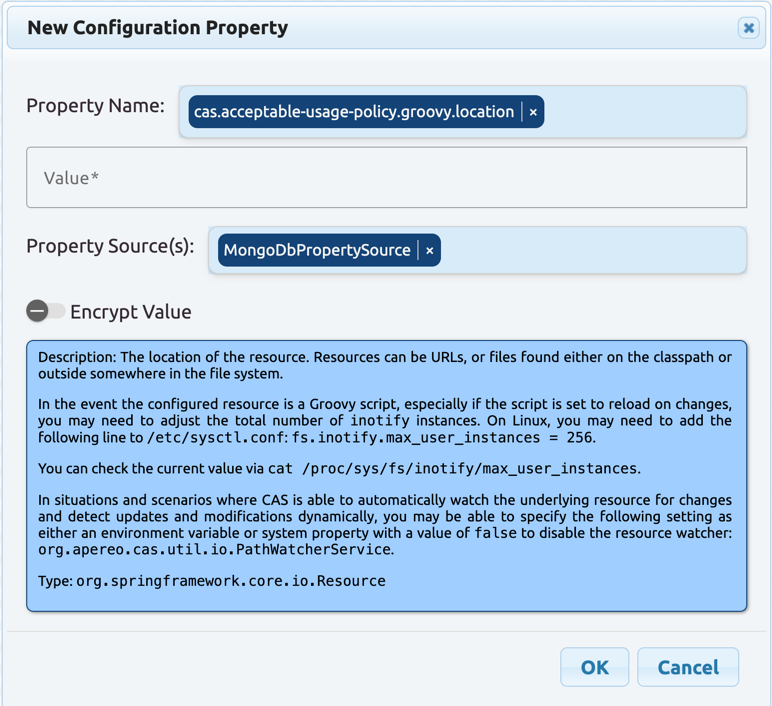
Note that the documentation for each configuration property is directly extracted from the CAS configuration catalog and may not be immediately available if the property is not fully documented, particularly if it’s owned and managed by a third-party library.
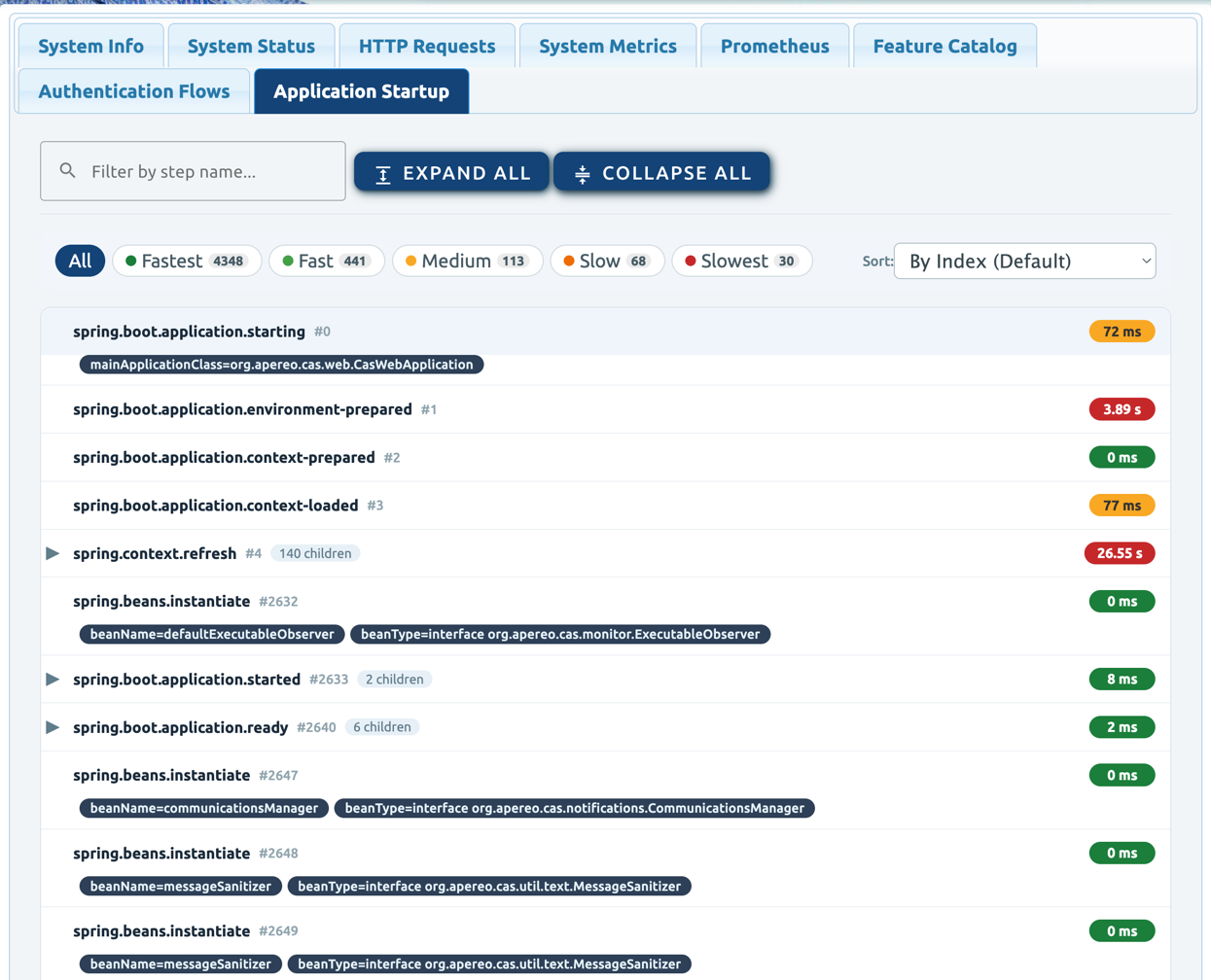
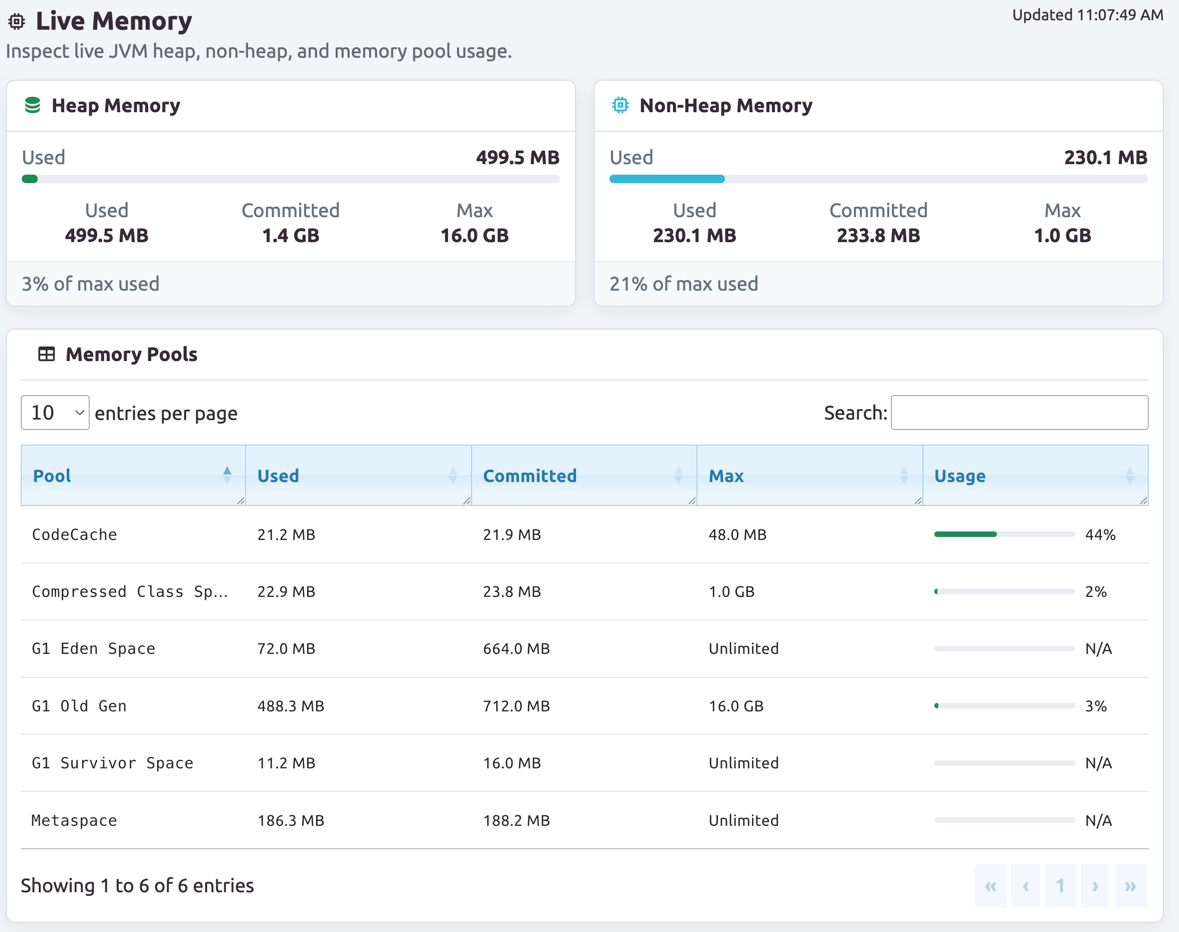
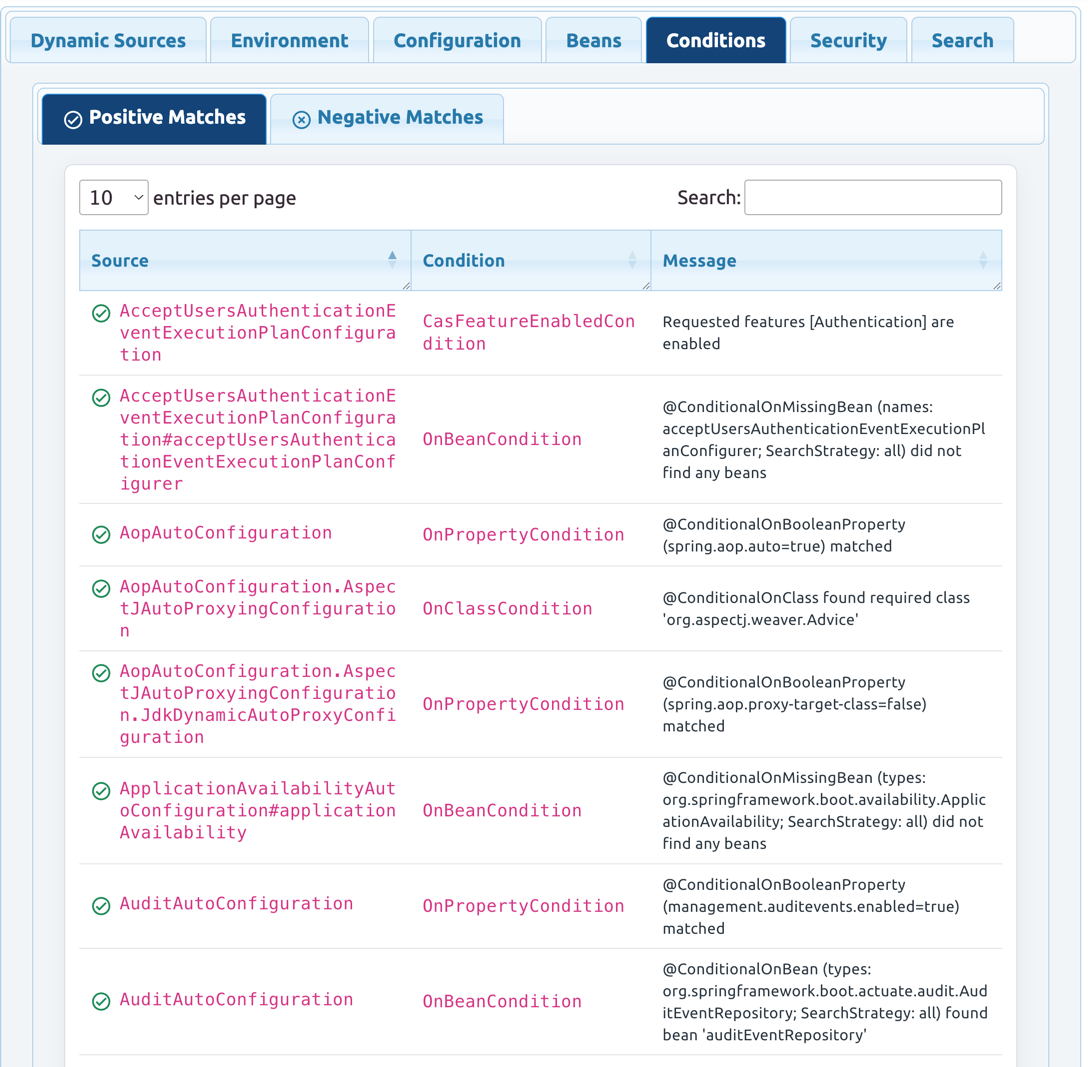
Palantir dashboard is now also able to present dedicated views for all beans in the application context, conditions that allowed those beans to be rejected or created, as well as a dedicated trace of application startup timeline and a live view of the JVM memory consumption and allocation.
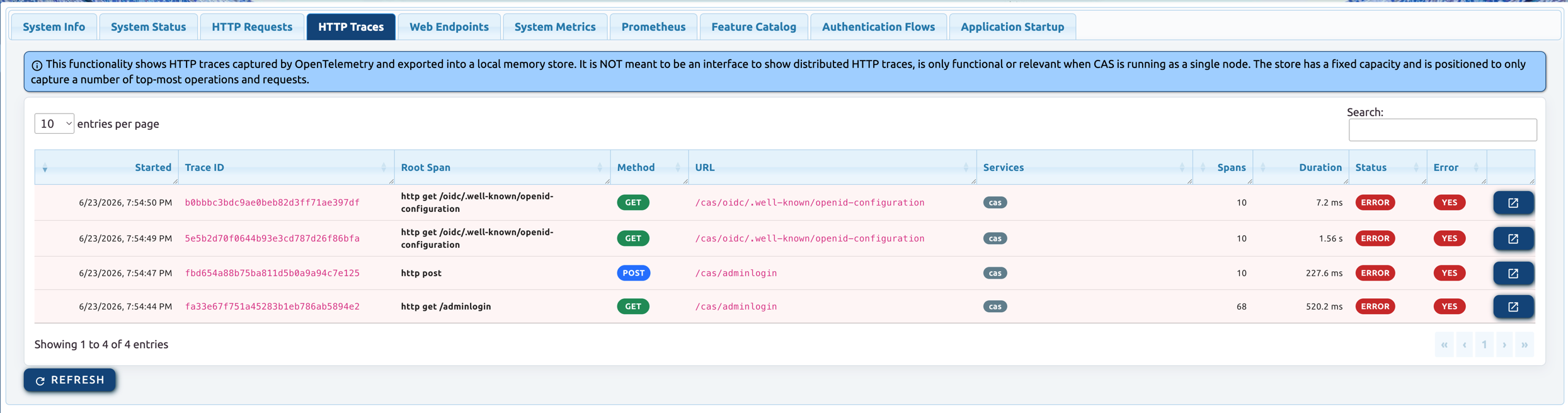
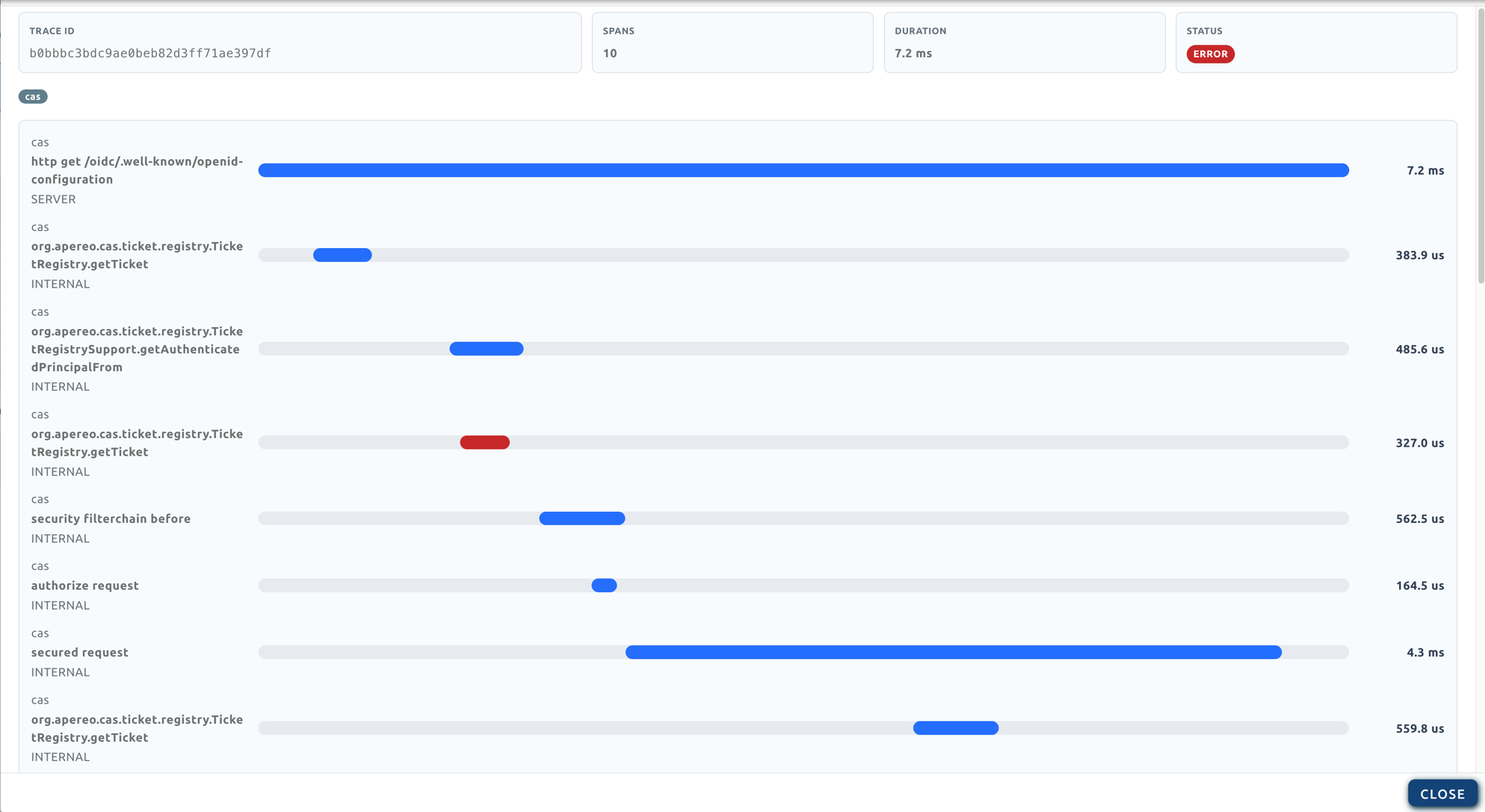
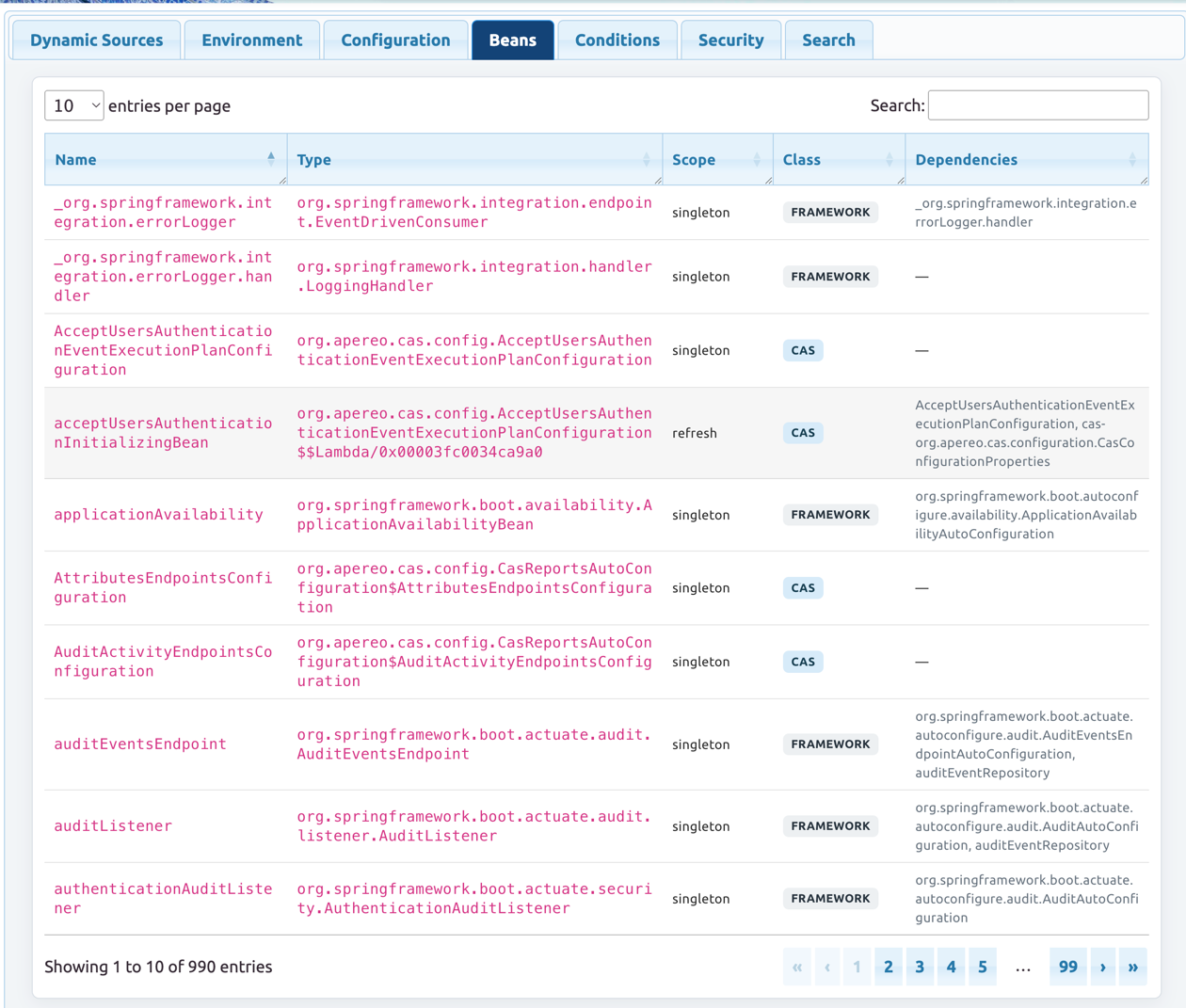
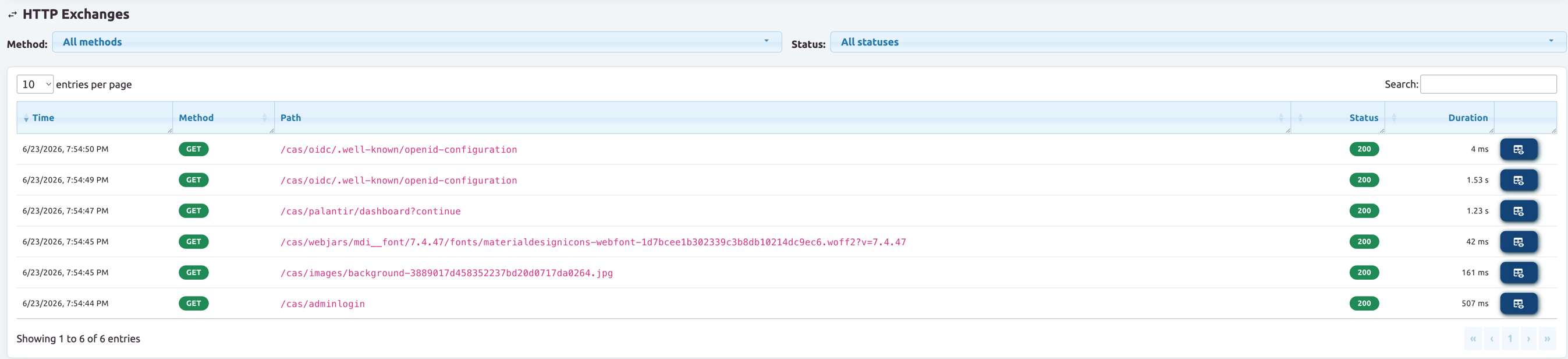
Palantir’s audit log table is also reworked to present structured resource details directly from the Resource column.
Audit records that carry JSON-like resources now offer an inline expand action that reveals a syntax-highlighted JSON detail row,
removing the older separate details column and nested table rendering for a cleaner and more readable audit view.
Redis Ticket Registry
The Redis Ticket Registry now presents several notable changes, particularly important when administrative logouts are exercised:
- Delete operation signals are now propagated to all other consumer CAS nodes when Redis messaging is enabled.
- Local cache invalidation is now restored to use the correct cache key when consumer CAS nodes receive a delete operation signal.
- Removing SSO sessions based on a principal now also propagates delete operation signals to consumer CAS nodes and invalidates the local cache for the publisher CAS node.
There are also significant performance optimizations available to ensure entries in Redis carry smaller objects:
- RedisSearch disabled/unavailable: often
45-70%less memory per ticket record, because JSON documents stored are compressed and the registry stops writingserviceandattributesfields into entries. - RedisSearch enabled: likely
40-65%less per ticket record, mostly from compressed JSON documents. - Crypto operations enabled: much smaller gain, often near
0-15%, because CAS stores an encoded/encrypted ticket payload that is already high entropy.
Single Sign-on Revocation
Single Sign-on participation can now be controlled globally using the
cas.sso.revocation-attribute-name setting. The attribute may be found in principal or authentication attributes, is expected
to carry a Unix epoch timestamp in seconds, and is evaluated during SSO participation checks so CAS can ignore an existing
SSO authentication when the timestamp indicates it should no longer participate.
Google Authenticator via Redis
Google Authenticator backed by Redis is now correctly tracking and updating scratch codes assigned to the principal, removing the possibility of lingering orphaned scratch codes.
Locale & Language Bundles
CAS language bundles for all supported languages are now comprehensively translated and include
all relevant language keys for each language. CAS themes also gain an option to enable and control a curated list of
available languages for user selection and displays. The user interface is also instructed to automatically set the
dir attribute on appropriate fields to support right-to-left languages automatically using the browser.
OpenID Connect Dynamic Client Registration
Several notable changes are now implemented for OpenID Connect Dynamic Client Registration to tighten and improve the security posture of registration request:
- Security rules that control access to the dynamic client registration endpoint are now hardened to prevent abuse and unauthorized access.
jwks_urifield in dynamic client registration requests cannot be include any spring expressions.jwksfield in dynamic client registration requests cannot be include any spring expressions.- Detailed error messages and root causes, as the result of invalid JSON keys, are no longer reported verbosely back.
Other Stuff
- OpenID Connect logout requests may now also be submitted via
POST. - Redis integration tests have switched to use Redis
8.8.x. - MongoDb integration tests have switched to use MongoDb
8.x. - The Spring Expression Language parser is tightened to run in a sandboxed environment.
- Delegated authentication can now handle JSON serialization of complex attribute definitions that may carry maps.
- Small enhancements to CAS audits to correctly identify the audited principal, particular for FIDO2 WebAuthn flows.
- Delegated authentication logout requests can now redirect to the original application as instructed when working with external OpenID Connect providers.
- A series of performance improvements to MongoDb and DynamoDb ticket registry implementations.
- Groovy attribute repositories are no longer required to return a
usernameattribute. - A large number of dependencies and libraries have been updated to their latest versions.
- Hardened crypto operations to protect against nonce reuse and replay attacks when managing webflow execution states.
- Delegated authentication will capture and translate
authnContextClassattribute if the response from the external identity provider carries an MFA context that can be mapped to a CAS multifactor authentication provider for the effective principal.